

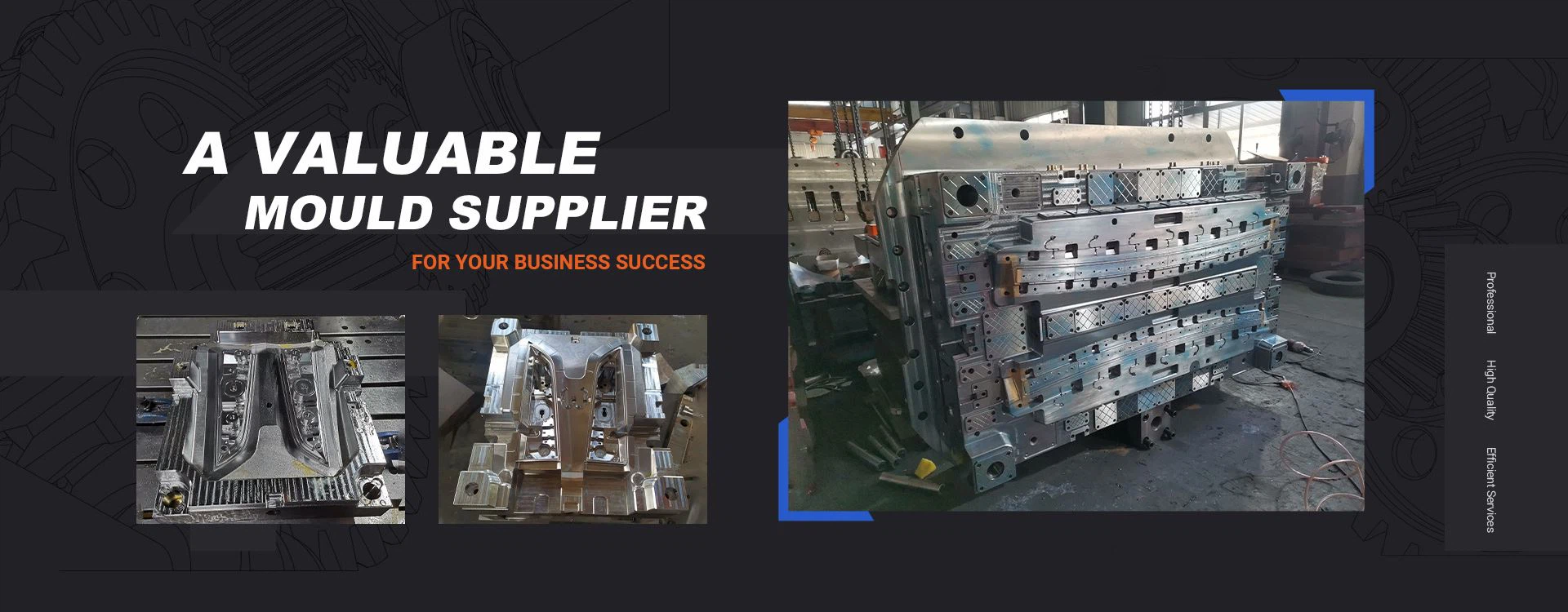


Grille Mould
What is Grille Mould
Grille mould is an injection tool for producing plastic grilles. It is custom-made according to product features and customer's molding production requirements. The grille on a car provides ventilation for the engine compartment, allowing air to flow in and cool the engine. It can help to improve aerodynamics by directing airflow around the car, reducing drag and increasing fuel efficiency. The grille can also serve as a design element, giving the car a distinctive look and helping to differentiate it from other models. Finally, the grille can provide protection for the radiator and other engine components, preventing debris and other objects from causing damage.
Highlights of Grille Mould
Features
High precision and tight tolerances are essential to ensure that the grille meets the required aesthetic and functional standards.
Moulds are often made from high-grade tool steels to withstand the high pressures and temperatures of the injection molding process.
Venting systems are incorporated into the mold to allow for the escape of air and gases during the injection process, preventing defects such as air traps and burns.
Mould Design
Mould design for car grille molds involves careful consideration of part geometry, material flow, cooling, and ejection.
Mold designers use computer-aided design (CAD) software to create detailed 3D models of the mold components and simulate the injection molding process.
Gate locations are strategically placed to ensure even material flow and minimize the appearance of gate marks on the finished part.
Draft angles and texture patterns are applied to the mold surfaces to facilitate part release and achieve the desired surface finish.
Mould Actions
Injection molding machines use hydraulic or electric actuators to open and close the mold, inject the molten plastic material, and eject the finished part.
The mold may incorporate slides, lifters, or collapsible cores to create undercuts or complex features that cannot be formed with a simple two-part mold.


Why Choose Us
One-stop solution
With rich experience in mould industry,we provide one-stop service from product design, mould manufacturing to final production.
Cost Effectiveness
We strive to provide competitive price without compromising on quality, offering you value for your investment.
Innovation
Our team stays updated with the latest technologies and techniques in mould making, allowing us to provide innovative solutions that enhance your molding production processes.
On-time Delivery
We understand the importance of meeting deadlines. Our efficient processes enable us to deliver your mould on time, keeping your production schedule on track.

Grilles usually have three positions in automobiles:
● A: Air intake grille (radiator grille)
● B: Bumper grille
● C: Buffer grille
In addition to the beauty of the front grille, the biggest role is to intake air and reduce air resistance. The greater the impact of the front grille on the resistance of the engine compartment, engine compartment resistance accounts for about 10% of the overall resistance, the grille active closure is conducive to reducing the resistance in the engine compartment.A and B are exterior parts that are common to all car models, so we will focus on them. C is a functional part that is not usually seen by users in the interior of the car, and not all car brands have such products.
The automobile grille is an exterior part and has weather resistance requirements.
The surface treatment of air inlet grille is usually high gloss polished, sandblasting, painting, electroplating, and the materials are usually PP, ABS, ASA, etc.
The grille is an exterior part with high surface quality requirements. Due to the limitation of product structure, it is difficult to eliminate the fusion marks. How to control the position of the fusion marks is a very important problem for these products.

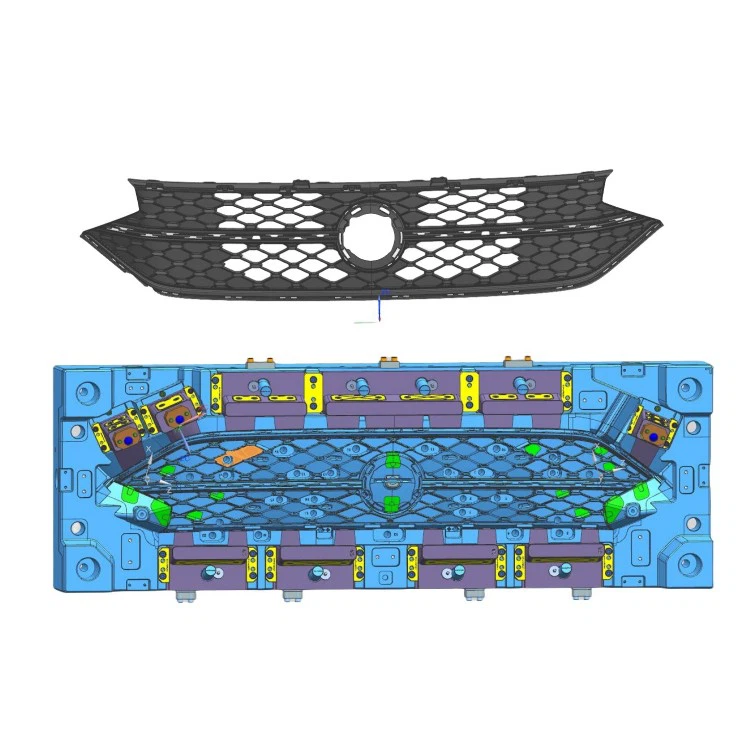
The grids can be divided into irregular grids and square grids according to the shape of the mesh. The problem of fusion marks is more pronounced for square-hole grids, but it is easier to solve these problems in terms of mold construction.
The grid is usually different in two directions, one for the main body, and the other for the secondary reinforcement, The presence of fusion marks in the main direction is a concern, so fusion marks should be. The fusion marks are located in the secondary position.
The grid parting line is complex and the parting surface needs to be designed according to a certain rule, not arbitrarily, to avoid problems with the mold. The slope of the release at the product grid is usually not large, . Therefore, the design should be checked against the surface treatment requirements. If the product has a rib position in the front and rear mold, it is necessary to check the release slope of the front and rear mold, which is usually larger than the rear mold, to avoid the product staying in the front mold.
CNC Machining Requirements For Automotive Grille Moulds
Fractal surface and piercing tabs as far as possible do not turn the angle cnc machining (pay attention to tool wear, choose a longer life tool cnc machining), steep straight penetration surface and other must turn the angle cnc machining should be first end mill milling a section of the benchmark before turning the angle to align.
Spark pattern area can not light knife (pay special attention to the fine parts of the tool path control), must ensure that 0.2mm margin, and the tool path should be smooth, not directly equal to the height of the trace directly discharge machining.
Pay attention to the convex and concave die benchmark edge and the position of the guide pillar hole is consistent, before finishing and then review a benchmark.
3 + 2 Axis or 5 axis cnc machining machines finishing tool and tool shank selected as short as possible to reduce the head error. The number of times the parting surface is turned should also be as few as possible.
Corresponding to the concave mold components at the parting surface without boundaries should be left 0.03mm margin.
Grille class mold cavity is more complex, it is recommended that the first 16r0.8 or 8R1 overall 0.15MM equal height!
D16R0.8 cutting parameters: speed 2000, feed 3000, depth of cut 0.3MM
D8R1 cutting parameters: speed 4000, feed 3000.
D4R0.5 tool to leave 0.15MM margin clear angle cnc machining.
D4R0.5 cutting parameters: speed 6000, feed 2000, depth of cut 0.12MM
Maximum clamping 28MM, maximum effective 16MM
D3R1.5 tool to leave 0.15MM margin clear angle processing
D3R1.5 cutting parameters: speed 10000, feed 2000, depth of cut 0.12MM
Maximum clamping 28MM, maximum effective 10MM
8r4 overall 0.08mm margin 3D offset finishing! Forming separate, no interface together, runners sealed!
D8R4 cutting parameters: speed 9000, feed 3500, depth of cut 0.5MM
D4R2 tool to leave 0.08MM margin with clear angle finishing toolpath processing, local V angle and other high-definition angle.
D4R2 cutting parameters: speed 9000, feed 2200, depth of cut 0.15MM (maximum clamping 28MM, maximum effective 12MM)
D2R1 tool to leave 0.08MM margin with clear angle finishing toolpath processing, local V angle and other high-definition angle.
D2R1 cutting parameters: speed 12000, feed 1700, depth of cut 0.08MM (maximum clamping 28MM, maximum effective 8MM)
Parting surface mouth and unbounded place, breakdown all processing out!To have a test to ensure the size!
The middle of the large breakdown with R2 tool processing, milling is not in place where the angle of the pendulum joint.
Too long knife path apart then try to choose at the molding!
Parting surface periphery and molding finishing!
Select D8R4 or D4R2 tool finishing
Overall clear corner, parting surface penetration class sharp angle at least milling to r0.5, milling to r0.25 conditions!
The final shape do not forget, isometric plate, pin hole platform light a knife. If there is a wear plate precision positioning benchmark do not forget to pull!
In the process of the existing injection mold from the nozzle outlet of the injection molding machine through the runner to the gate, due to the temperature reduction, part of the plastic will solidify, causing waste of raw materials, and the runner is easy to be blocked.
Now there is a hot runner mold on the market, which can keep the temperature in the runner within a proper range to prevent plastic solidification. The hot runner mold mainly includes injection nozzle, nozzle, splitter plate and temperature control box used to control the temperature of the hot runner. Multiple sets of power transmission lines are connected to the temperature control box to provide energy to make the temperature of the hot runner moderate. In order to prevent damage to the power supply circuit caused by the mold with higher temperature, A protective shell is usually provided, and the power supply circuit passes through the protective shell, and the protective shell is fixed with the mold.
The Automotive Grille Structure
The overall dimension of car grille is 1520mm × 475mm × 290mm, no spot, gate trace, shrinkage depression, weld line, flash and other defects are allowed during molding. The grid is arranged in blocks. The strength of connecting bars between grids is weak. The grid bars are small, numerous and deep, up to 52mm deep. It is difficult to fill. In addition, there are many grid reverses, and the demoulding mechanism and the ejection mechanism are dense during mold design.

Automotive Grille Mould Design
Gating system design. Automobile grille is a kind of exterior part with high surface quality requirements. Due to its structure limitations, such as many grids and poor melt filling fluidity, it is critical to effectively control the position of weld lines through gating system design.
In order to make the weld mark not on the appearance surface of the plastic part, the gate is set on the side of the straight push block, which increases the design difficulty of the push out system. The design of the ejection mechanism affects the molding quality of the plastic parts. If the design is not reasonable, it will lead to warping deformation, cracks, push rod marks and other defects of the molded plastic parts.
Cooling system design. The large height drop of plastic parts, small, many and deep ribs, and high precision requirements lead to complex mold structure. How to effectively control the deformation of plastic parts through the cooling system is also the key point of mold design.
Mould Working Process
Injection
The melt plastic enters the mold cavity through the hot runner; The melt enters the common runner through the hot runner and then enters the mold cavity through the side gate; The melt enters the runner in the direct pushing block of the lower mold from the upper mold through the hot runner, then enters the runner in the direct pushing block of the lower mold from the side gate, and then enters the mold cavity from the side gate. After filling the cavity, the melt is kept under pressure, cooled and solidified.
Open the mold
Under the action of the injection molding machine, the mold leaves the lower mold from the parting surface.
Pick up the plastic piece
The nitrogen spring and the piston rod of the hydraulic cylinder directly drive the secondary push plate, and the primary push plate moves 80mm through the mold lock to push the condensate in the side channel on the straight push block out of the parting surface. The condensate in the side channel on the straight push block of the hydraulic cylinder piston pushes out the parting surface. The piston rod of the hydraulic cylinder continues to push out for 50mm, and the condensate in the inner channel of the straight pushing block is forced to demould. At the same time, the plastic parts are pushed out together, and the manipulator takes the parts.
Mold closing
The secondary ejection mechanism and the primary ejection mechanism are closed, waiting for the next injection cycle.
How Ejector Rods Function on Car Grille Mould
Several types of injection moulding machines are equipped with adjustable ejector rods which operate essentially as follows: Assume the machine opens eight inches and the casting must be pushed out of a one-inch cavity or off a one-inch core. When seven inches of the movement is accomplished the ejector rod will strike the ejector plate. The ejector rod itself is detail 1. If the plate travels toward the parting line plane, the ejector pins will lift the casting off the raised cores, the sprue pin will protrude from the core retainer plate, and the casting will be free to fall or to be moved from the mould. Surface or push back pins will be pushed out of the ejector mould half in the same manner as the sprue and ejector pins. The surface pins push the ejector plates along with the ejector pins back into the moulding position by contact with plate 19 as the mould closes.
The ejector box can be of cast iron, burned out of machine steel or machined out of the solid. The latter method is rather costly and sometimes wasteful if the ejector box is deep. The box is lathe machined and later finished by grinding the surface that fits against the core retainer plate. The box is fastened by four socket head screws through a clearance drilled hole in the core backing plate into tapped holes in the core retainer plate. In many cases the ejector plates are cold rolled steel—the ejector pin retainer plate is drilled first for all holes. The holes are countersunk to provide for peening on the drill rod pins (peened before hardening). The ejector pin retainer plate is then fastened to the knockout side of the ejector plate. The plates can be machined together. Ample clearance all around should be allowed for the plates where they fit into the ejector box bore.
The core insert back-up plate in this case is specified to be made of alloy steel to provide resistance to sinking of the cores in service. This plate is lathe machined and ground on both sides. All pin holes are clearance drilled with the exception of the sprue and surface pins—these should be lapped fits. Four socket head screws extend through this plate into the core retainer plate. Some China car grille mould makers believe that it is advantageous to place socket head screws close to the inserts to prevent moulding carbon, formed by gases present in moulding, from forming under the cavity inserts, thus assuring a cleaner and more positive mould.
The boring of insert retainer holes in the core and cavity retainer plates must be done carefully; guide pin bushing and sprue pin hole must also be bored carefully since mating core and cavity inserts are nitride or matched before assembly and ground for parallelism. The guide pin bushings are press fitted in this core retainer plate. The guide pins are press fitted in cavity insert retainer and cavity back-up plates. The cavity insert back-up plate is made of alloy steel, lathe machined as is its counterpart, the core insert backing plate.