



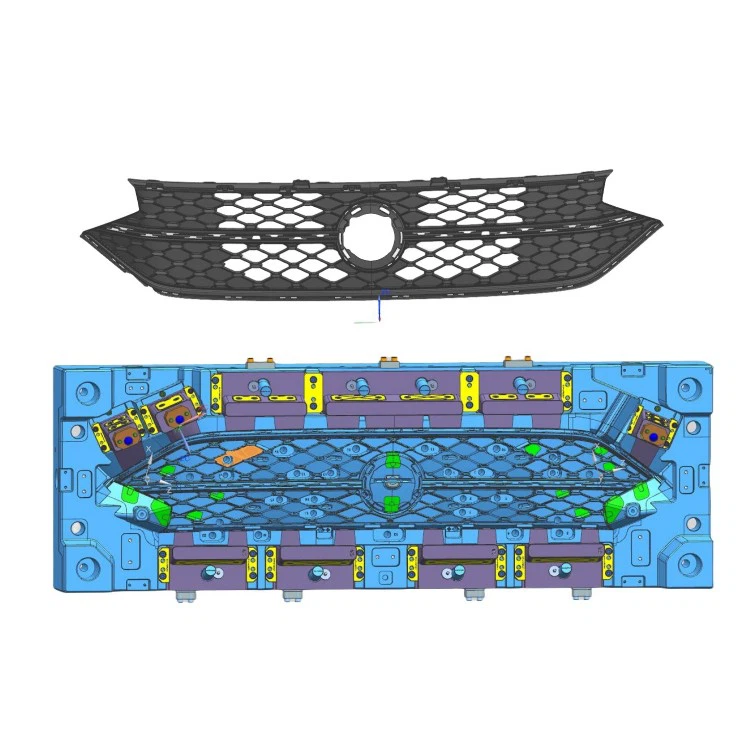


Plastic Grille Mould
Products Description
|
Mould name |
Plastic grille mould |
|
Plastic resin |
ABS or PC+ABS or PP |
|
Numbers of mould cavity |
Single cavity |
|
Gate and runner |
Hot runner or cold runner |
|
Core and Cavity steel |
P20 or 718 steel |
|
Mould base steel |
1045 steel |
|
Injection machine specification |
800 Tons |
|
Mould manufacturing time |
75 days for T1 mould trial |
|
Cycle time |
50-60s |
|
Mould life |
≥ 300,000 shots |

Grille is also known as car front face, ghost face, and water tank guard, etc. Its main function is to provide air intake and ventilation for water tanks, engines, air conditioners, etc., to prevent damage to internal components of the vehicle by foreign objects during driving, and to enhance its appearance and personality.
Generally, grilles are made of ABS, and some of them need plating process that provides a shiny and reflective surface finish. So what about surface finish for plastic grille mould?
The surface finish of plastic injection moulds for car grilles is critical to achieving the desired appearance and functionality of the final product. Here are some common surface finishes used in the production of car grille moulds:
- High gloss: A smooth and shiny surface that provides a mirror-like finish. This is commonly used for grilles that require a premium look, such as luxury vehicles. If the product need plating process, then it needs high gloss polishing on mould surface.
- Textured: A complex pattern or texture that provides a unique appearance and enhances functionality. This can include patterns like mesh, honeycomb, or diamond shapes, which can improve airflow or increase strength.
- Matte: A flat and non-reflective surface that provides a modern and understated look. This is commonly used for grilles that require a sleek and sophisticated appearance.
- Satin: An intermediate finish between matte and gloss that provides a soft and semi-reflective appearance. This is often used for grilles that require a subtle and refined look.
The selection of the appropriate surface finish for a car grille depends on the desired aesthetics and functional requirements. The surface texture can significantly affect the part's performance, such as airflow resistance or impact resistance, and must be carefully considered during the mould design process. Ultimately, the surface finish must meet the customer's expectations and match the overall style of the vehicle.
Is gate placement on mould related to product surface requirement?
Of course! Gate placement is an essential aspect of plastic injection mould design for car grilles. The gate is the point through which molten plastic enters the mould cavity, and its location affects the part's final appearance and mechanical properties. Here are some general guidelines for gate placement in car grille moulds:
Position the gate away from visible surfaces: To minimize visible gate marks on the final part, position the gate at a location that is not visible or easily concealed, such as near corners, edges, or natural flow lines.
Select an appropriate gate type: Different gate types, such as edge gates, sub-gates, or hot runners, have different advantages and disadvantages. Consider the material, part geometry, and production volume when selecting the appropriate gate type.
Balance filling and packing: The gate location should be chosen to balance filling and packing requirements. If the gate is too small or located in an inappropriate position, the part may not fill properly or exhibit sink marks or warpage.
Minimize weld lines: Weld lines are formed when two flow fronts meet and solidify, causing a visible seam on the part. Place the gate in a location that minimizes the number of weld lines and ensures maximum strength.
Optimize cooling: Gate placement affects the cooling rate and overall cycle time of the mould. Choose a gate location that promotes uniform cooling and ensures consistent part quality.
Consider part ejection: Select a gate location that allows for easy part ejection from the mould. Avoid locating the gate in areas where the part might become trapped or difficult to remove.
Our engineering team will optimize the gate placement in your car grille mould design, leading to improved part quality, reduced cycle times, and increased production efficiency.
Hot Tags: plastic grille mould, China plastic grille mould, chevrolet bumper mould, transparent light bar mould, trash can mould, plastic desk mould, Plastic Table Mould, car grille mould
Previous
No InformationYou Might Also Like


Send Inquiry