

What is a vent?
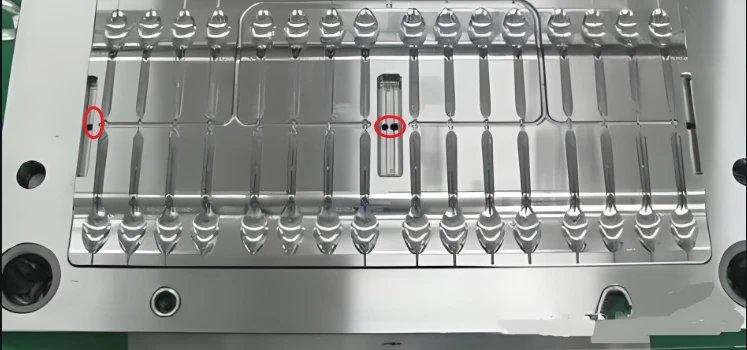
It is a slot-shaped vent opened in the mold to discharge the original gas and the gas brought in by the molten material. When the molten material is injected into the cavity, the air originally stored in the cavity and the gas brought in by the molten material must be discharged to the outside of the mold through the vent at the end of the material flow, otherwise the product will have pores, poor connection, incomplete mold filling, and even the accumulated air will be compressed to generate high temperature and burn the product.
In general, the vent can be set at the end of the molten material flow in the cavity or on the parting surface of the mold. The latter is a shallow groove with a depth of 0.03-0.2mm and a width of 1.5-6mm opened on one side of the concave mold.
During injection, there will not be much molten material seeping out of the vent, because the molten material will cool and solidify there and block the channel. The vent should not be opened facing the operator to prevent the molten material from accidentally spraying out and injuring people. In addition, the clearance between the ejector rod and the ejector hole, the clearance between the ejector block and the stripper plate and the core, etc. can also be used to exhaust.
The role of the exhaust groove
The exhaust groove has two main functions: one is to remove the air in the mold cavity when injecting the molten material; the other is to remove various gases generated by the material during the heating process. The thinner the wall of the product is, the farther away from the gate, the more important it is to open the exhaust groove.
In addition, for small parts or precision parts, the opening of the exhaust groove should also be taken seriously, because in addition to avoiding surface burns and insufficient injection volume of the product, it can also eliminate various defects of the product and reduce mold pollution.
So, how can the exhaust of the mold cavity be considered sufficient? Generally speaking, if the molten material is injected at the highest injection rate and no scorch marks are left on the product, it can be considered that the exhaust in the mold cavity is sufficient.
Exhaust method
There are many ways to exhaust the mold cavity, but each method must ensure that: while exhausting, the exhaust groove should be designed to prevent the material from overflowing into the groove; secondly, it must prevent clogging. Therefore, when measuring from the inner surface of the mold cavity to the outer edge of the mold cavity, the height of the exhaust groove part longer than 6-12mm should be enlarged by about 0.25-0.4mm.
In addition, too many venting grooves are harmful. Because if the clamping pressure acting on the part of the mold cavity parting surface without venting grooves is very high, it is easy to cause cold flow or cracking of the mold cavity material, which is very dangerous.
In addition to venting the mold cavity on the parting surface, the purpose of venting can also be achieved by setting venting grooves at the end of the material flow of the casting system and leaving gaps around the ejector rod. Because if the depth, width and position of the venting groove are not selected properly, the flash burrs will affect the beauty and precision of the product. Therefore, the size of the above gap is limited to prevent flash from appearing around the ejector rod.
It should be noted here that when venting parts such as gears, even the smallest flash may not be desired. This type of parts is best vented in the following ways:
- Thoroughly remove the gas in the flow channel;
- Use silicon carbide abrasive with a particle size of 200# to shot peen the mating surface of the parting surface;
- Opening a venting groove at the end of the material flow of the casting system mainly refers to the venting groove at the end of the branch channel. Its width should be equal to the width of the branch channel, and the height varies depending on the material.
Design method
Based on many years of experience in injection mold design and product trial mold, this article briefly introduces several venting groove designs.
For product molds with complex geometric shapes, it is best to determine the opening of venting grooves after several trial molds. The biggest disadvantage of the overall structural form in the mold structure design is poor venting.
For the overall mold cavity and core, there are several venting methods:
- Use the groove or insert installation part of the cavity
- Use the insert joint on the side
- Partially make a spiral shape
- Install a grooved slat core and open a process hole in the longitudinal position
- When venting is extremely difficult, use an inlay structure, etc.
If some molds have dead corners that are not easy to open venting grooves, first of all, the mold should be appropriately changed to inlay processing without affecting the appearance and precision of the product. This is not only conducive to processing venting grooves, but sometimes it can also improve the original processing difficulty and facilitate maintenance.
Venting groove design during thermosetting plastic molding
The venting of thermosetting materials is more important than that of thermoplastic materials. First of all, the runners in front of the gate should be vented. The width of the venting groove should be equal to the width of the runner and the height should be 0.12mm. The mold cavity should be vented all around. Each venting groove should be 25mm apart, 6.5mm wide and 0.075-0.16mm high, depending on the fluidity of the material.
Softer materials should take lower values. The ejector pin should be enlarged as much as possible, and in most cases, 3-4 planes with a height of 0.05mm should be ground on the cylindrical surface of the ejector pin, and the grinding direction should be along the length of the ejector pin. Grinding should be carried out with a finer grinding wheel. The end face of the ejector pin should be ground with a chamfer of 0.12mm, so that if flash is formed, it will adhere to the part.
Conclusion
Properly opening venting grooves can greatly reduce injection pressure, injection time, holding time and clamping pressure, making plastic part molding easier from difficult, thereby improving production efficiency, reducing production costs, and reducing machine energy consumption.


