






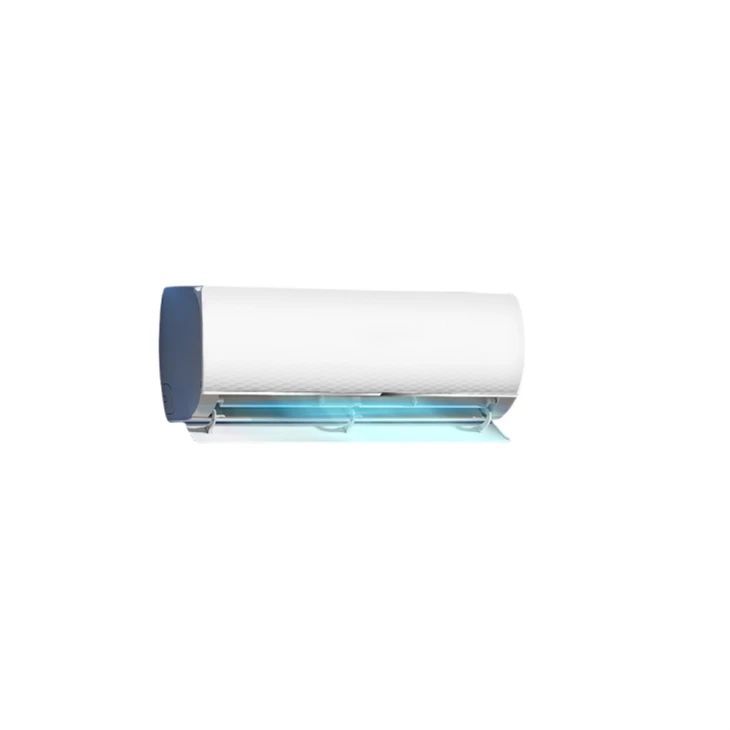
Household Air Conditioner Mould
Products Description
For household air conditioner mould, the choice of steel is critical in manufacturing a high-quality mould. Typically, a high-grade tool steel, such as P20 or 718 or H13, is used due to its ability to withstand the high pressures and temperatures involved in the injection process. After rough CNC machining, the steel is heat treated to increase its strength and durability.
At our factory, we machine the mould using high-speed even 5-axis CNC machines to assure high precision. To prevent defects and ensure a high-quality finish on the air conditioner housing, the mould is carefully polished to a mirror-like finish. This helps to eliminate any imperfections that could affect the final product.
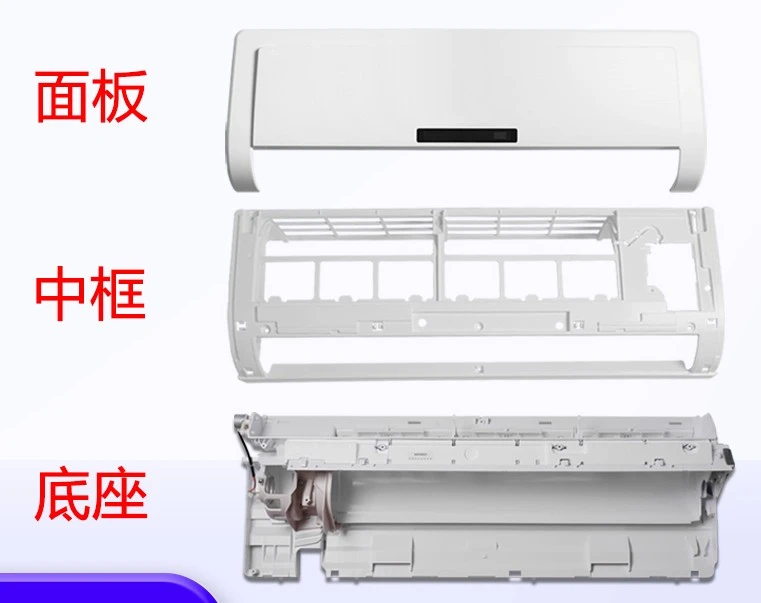
Let's take the air conditioner base mould for example to talk about the details of mould design and manufacturing.
The base shell materials is ABS/HIPS. The wall thickness of the product is between 2.0-2.8mm. There are multiple ribs and buckles on the product.
Demoulding structure
The focus of the design of the hang-up base is the processing of the demoulding structure.
If the mold opening direction is based on the parting surface, demoulding needs to be performed on the air outlet of the air conditioner and the stud holes above, and the combined slider structure must be correctly used. For a round hole with a diameter of 7mm, it is necessary to combine the slider and the horizontal inclined roof structure to pave the way for the demoulding operation. In the design of the drainage hole, it is necessary to closely combine the oblique core pulling, slider and oil cylinder mechanisms, supplemented by the expansion of demoulding. For stud holes, it is necessary to use a combination of oblique core pulling, oblique guide pillars, and slider structures to achieve the final conditions for demoulding. In the external surface buckling process, it is necessary to combine the inclined guide pillar with the slider to finally complete the demoulding operation.
For the air deflector holes at both ends of the base, it is also necessary to use the combination of inclined guide posts and slide blocks to carry out demoulding operations. The key point is to fasten the inner surface of the base, and the method of fixed mold and inclined roof must be correctly used to complete the demoulding work. Only by completing this series of demoulding operations can the mold be produced reasonably and avoid product breakage and deformation during injection molding.
Feeding system
The current hang-up base structure is relatively complex compared to other injection molded products, and the product is large in size and has many ribs. In order to avoid cracking and deformation of the air conditioner base during the injection molding process, it is necessary to focus on improving the feeding system. First, use the hot runner feeding system to keep the axes of the round holes at both ends of the base and the round holes (both 7mm in diameter) on the side hole ribs on the same straight line. At the same time, no less than 7 glue entry points should be set up. Again, attention should be paid to controlling the mold temperature during injection molding operations [1]. If the glue mouth is properly set, the molten material will be filled into the mold cavity. Even if there is residual gas in the mold cavity, it can be smoothly discharged, thereby effectively reducing pore defects in the product. What cannot be ignored is that if the molten material stays inside the base for a long time, more heat will be lost. If the filling speed is slow, the molten material will quickly cool and solidify when it is filled into the cavity, which will seriously weaken the product. Filling capacity can easily lead to insufficient pouring and cold shutoff problems. For these problems, the injection pressure and injection rate of the feeding operation need to be appropriately adjusted. Usually, the injection rate can be increased and the starting point of injection pressure can be delayed to ensure the filling capacity and meet the quality requirements of injection molding.
Cooling system
During the injection molding of the air conditioner base, in order to avoid deformation of the base, it is necessary to design a complete cooling system for the mold to give full play to the function of this system. The water outlet hole must be made of beryllium copper or 3D printed to ensure sufficient local cooling and ensure that all parts of the mold are The parts are kept at basically the same temperature to avoid warping and deformation at the water outlet of the base caused by large temperature differences. It must be noted that the fixed mold, movable mold, slider and inclined roof of the air-conditioning base mold are all relatively large in size. To improve the cooling system, it is necessary to set up cooling water channels for them respectively to ensure that the water channels must be close to the glue level.
Any question or interested to household air conditioner mould, welcome to get in touch with our team. We always like to hear from you!
Hot Tags: household air conditioner mould, China household air conditioner mould, automotive fog light mould, Plastic Toy Mould, door outside handle mould, Trim Panel Mould, double tub washing machine mould, shopping basket mould
Previous
Mini Washing Machine MouldYou Might Also Like




Send Inquiry