

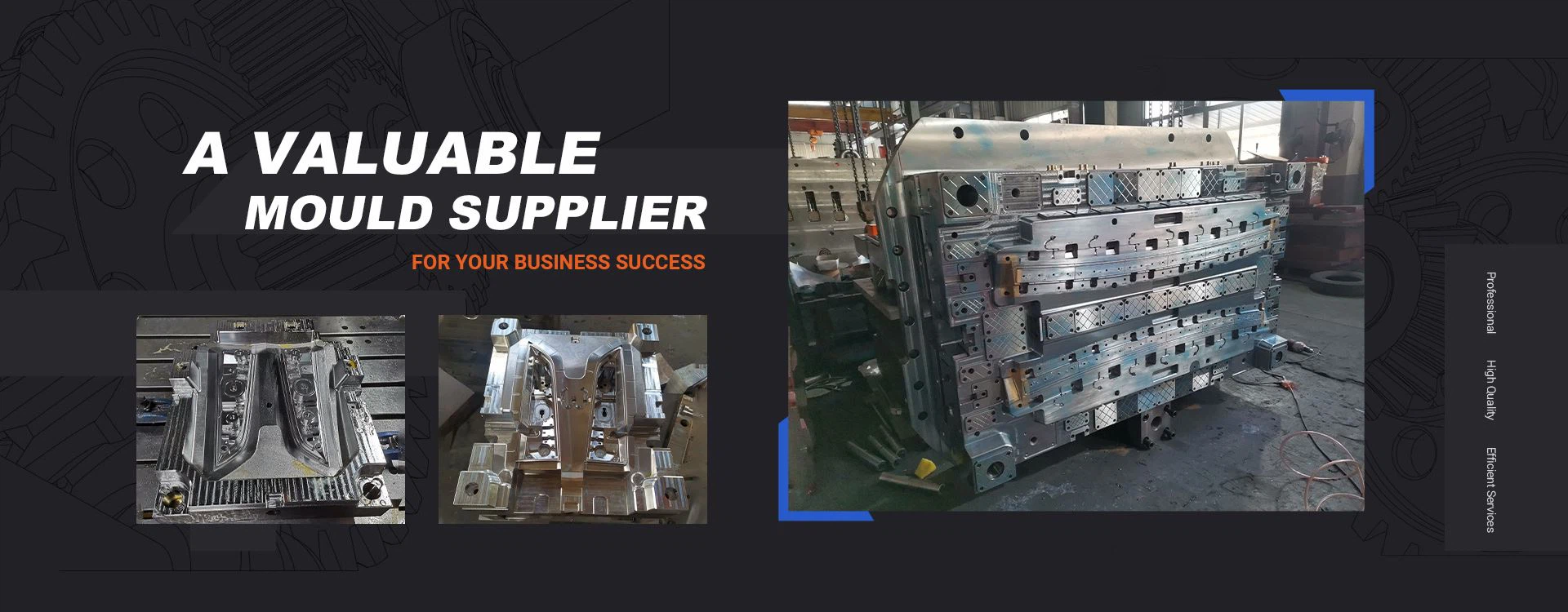


Front Bumper Mould
Products Description
Our company's front bumper mould is a good quality product that offers several advantages to our customers. Firstly, it is made from durable and long-lasting materials, ensuring that it can withstand constant use in the production process. Secondly, it is designed with precision and accuracy, allowing for consistent production of front bumpers with uniform shapes and dimensions. This helps to reduce waste and increase efficiency in the manufacturing process. Additionally, our mould is easy to use and maintain, providing our customers with a hassle-free experience. Finally, we offer excellent customer service and support, ensuring that our customers receive the best possible experience when using our mould. Overall, our bumper mould offers reliability, precision, and convenience, making it an ideal choice for any automobile manufacturer.
|
Mould name |
Front bumper mould |
|
Plastic resin |
PP+EPDM+TD20 |
|
Numbers of mould cavity |
Single cavity |
|
Gate and runner |
Hot runner |
|
Core and Cavity steel |
P20 or S50C steel with heat treatment |
|
Mould base steel |
1045 steel |
|
Injection machine specification |
1600 Tons |
|
Mould manufacturing time |
120 days for T1 mould trial |
|
Cycle time |
60-70s |
|
Mould life |
≥ 300,000 shots |

The bumper mould is an essential tool used in the automotive industry for the plastic injection production.
The mould is made from high-quality materials such as hardened steel with heat treatment, ensuring durability and longevity. This allows it to withstand the high pressures and temperatures involved in the injection molding process.
The design of the mould is crucial in achieving precise and consistent bumper shapes and dimensions. It is meticulously crafted with advanced CAD/CAM technology, ensuring accuracy and uniformity in every produced bumper.
The bumper mould finds its use in automotive manufacturing plants worldwide. It is compatible with various types of injection molding machines, making it versatile for different production requirements. Whether it is a small-scale operation or a large-scale production line, the bumper mould can accommodate the needs of any manufacturer.
Overall, our team provides auto parts manufacturers with reliable and efficient mould solutions for producing high-quality bumpers.
Mould steel material
We usually use 1045 steel for mould base, P20 or S50C hardened steel for core and cavities. Heat treatment process is necessary for steel material of bumper mould. And we will use special device to inspect the steel in ordering to ensure no sand holes inside steel.
Hot runner system
Mostly we use YUDO hot runner or Chinese local brand hot runner system, depending on customer's requirement. Our design team will do moldflow analysis to decide the numbers of hot runner tips and its best locations.
Cooling system design
Efficient cooling helps to reduce cycle times, improve part quality, minimize warpage, and enhance overall productivity. Here are some considerations for the cooling system design:
- Uniform cooling: The cooling system should be designed to provide uniform cooling across the entire mould cavity. This helps to ensure consistent part quality and reduces the risk of variations in shrinkage or warpage. Cooling channels should be strategically placed to achieve balanced cooling, considering the geometry and thickness of the car bumper.
- Balanced cooling: It is essential to achieve balanced cooling throughout the mould to prevent uneven cooling and potential part defects. The cooling system should be designed to distribute coolant evenly, ensuring that all areas of the mould receive adequate cooling. This can be achieved by employing a combination of cooling channels, baffles, and inserts.
- Optimal channel size and layout: The size and layout of the cooling channels should be optimized to maximize heat transfer and cooling efficiency. Channels should have sufficient diameter to allow for proper coolant flow without excessive pressure drop. The layout should consider factors like proximity to critical areas, avoiding interference with ejector pins or other components, and efficient heat dissipation.
- Cooling channel placement: Cooling channels should be strategically positioned to target areas of the mould that require the most cooling. This typically includes areas with thicker sections, hot spots, or complex geometries. By focusing cooling in these critical areas, it helps to minimize cycle times and reduce the risk of part defects.
- Baffle design: Baffles can be used in the cooling system design to control the flow of coolant and optimize cooling efficiency. Baffles help direct the flow of coolant to areas that require more cooling, ensuring balanced temperature distribution within the mould.
- Simulation and optimization: Advanced cooling system design can be achieved through the use of simulation software. Moldflow analysis or similar software can help simulate and optimize cooling channel layouts, sizes, and configurations, leading to improved cooling efficiency and part quality.
By considering these factors and utilizing advanced design techniques, the cooling system for a car bumper mould can be optimized for efficient heat transfer, uniform cooling, and improved productivity. Working with our skilled engineers can provide valuable insights and expertise in achieving an effective cooling system design.
Parting line
Bumper mold design generally adopts external parting and internal parting. The so-called internal parting is relative to the external parting. Usually, for general products, the maximum projected contour line of the product is used as the parting line of the fixed and movable molds. This is the external parting. Most molds follow this parting method.
Internal parting is to hide the parting clamp line on the non-appearance surface of the product (i.e. B side or C side, the appearance surface is A side). The parting clamp line cannot be seen after assembly on the whole vehicle, so it will not affect the Exterior. In order to realize this function, the rail technology is used to control the transverse inclined top (or straight top) on the mold structure to run on the secondary rail, thereby ensuring the deformation and demoulding of the plastic parts. The use of this secondary rail technology can The mechanism of control is called internal type. In the design of automobile injection molds, internal splitting technology is specially designed for automobile bumpers. However, this technology is more complicated in terms of difficulty and structure than externally split bumpers, and the technical risks are also higher. The mold cost and mold price will also be much higher than externally split bumpers. However, due to its beautiful appearance, it is widely used in mid- to high-end cars. is widely used in.
Any question or interested, welcome to send us your drawing or sample to get a quotation for your mould!
Hot Tags: front bumper mould, China front bumper mould, Plastic Jug Mould, plastic wheel cover mould, Dashboard Mould, foldable table mould, Plastic Pallet Mould, automotive fender mould
Previous
No InformationYou Might Also Like


Send Inquiry