



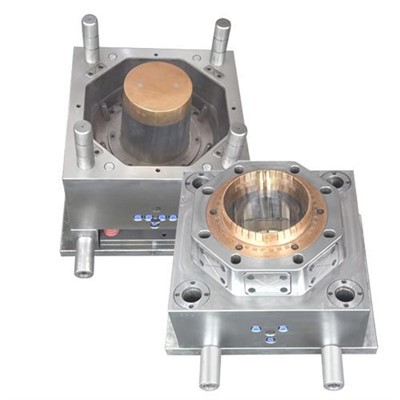
Garbage Bin Mould
Products Description
|
Mould name |
Garbage bin mould |
|
Plastic resin |
PP, PE |
|
Numbers of mould cavity |
Single cavity |
|
Gate and runner |
Hot runner or cold runner |
|
Core and Cavity steel |
P20/718/H13/2344/S136 steel |
|
Mould base steel |
1045 steel |
|
Surface finish |
Polishing |
|
Injection machine specification |
1000 Tons |
|
Mould manufacturing time |
60 days for T1 mould trial |
|
Cycle time |
55-60s |
|
Mould life |
≥ 300,000 shots |

Garbage bins, also named trash cans or dust bins, it can be divided into public trash cans and household trash cans depending on the occasion of use. In terms of the form of holding garbage, it can be divided into independent trash cans and classified trash cans. The opening methods include open type, uncovered type, pedal opening type, induction type (infrared), etc. Its capability is from 1L to 240L.
As a professional mould maker, here we concludes some tips for garbage bin mould designing and manufacturing.
Mould design
The design of the mould is a crucial first step in the engineering process. The design should take into account the specific requirements of the garbage bin, such as size, shape, wall thickness, and any special features or requirements. The design should be created using computer-aided design (CAD) software, which allows for precise calculations and measurements.
When it comes to selecting steel materials for plastic garbage bin moulds, there are several options commonly used in the industry. The choice of steel material depends on factors such as desired mould life, production volume, budget constraints, and specific requirements of the garbage bin. Here are some commonly used steel materials for plastic garbage bin moulds:
Mould steel material selection
- P20 steel: P20 is a versatile low-alloy tool steel that is widely used for plastic injection moulds, including garbage bins. It offers good toughness, excellent machinability, and polishability. P20 steel is relatively cost-effective and can provide a good balance between cost and performance.
- H13 steel: H13 is a hot-work tool steel known for its high hardness, wear resistance, and heat resistance. It is suitable for applications where the mould is subjected to high temperatures during the injection process, as it has excellent thermal stability. H13 steel is commonly used for high-volume production of plastic garbage bins.
- 718 steel: 718 is a pre-hardened steel material that offers good dimensional stability, high hardness, and corrosion resistance. It is often used in applications that require high precision and long mould life, making it suitable for producing high-quality plastic garbage bins.
These steel materials have proven to be effective for manufacturing plastic garbage bin moulds, but it's important to note that the selection may vary based on specific requirements and considerations. Other factors to consider include the complexity of the mould design, budget constraints, expected production volume, and the desired lifespan of the mould.
Injection molding simulation
Injection molding simulation is a valuable tool in the engineering process for garbage bin moulds. It involves using specialized software to simulate and analyze the injection molding process before actual production takes place. Here are some key benefits and aspects of injection molding simulation for garbage bin moulds:
- Optimize part design: Injection molding simulation helps optimize the design of the garbage bin by predicting how the plastic material will flow, cool, and solidify within the mould cavity. It allows engineers to identify potential issues early on, such as air traps, weld lines, or sink marks, and make necessary design modifications to improve part quality.
- Predict filling behavior: Simulation software can predict how the plastic material will fill the mould cavity during the injection process. This includes analyzing factors such as flow patterns, pressure distribution, and filling time. By visualizing the filling behavior, engineers can identify potential defects like short shots (incomplete filling) or flow imbalances and make adjustments to the mould design or process parameters accordingly.
- Cooling analysis: Effective cooling is crucial for achieving high-quality plastic parts. Injection molding simulation can analyze the cooling process and provide insights into temperature distribution, cycle times, and warpage tendency. Engineers can optimize the cooling system design, including the placement and sizing of cooling channels, to ensure uniform cooling and minimize part deformations.
- Warpage prediction: Warpage is a common issue in injection molding that can affect the dimensional accuracy and functionality of the garbage bin. Simulation software can help predict areas of potential warpage and guide engineers in making design modifications, optimizing gate location, or adjusting cooling strategies to minimize warpage.
- Process optimization: Simulation software provides valuable data and insights that can help optimize the injection molding process parameters, such as injection pressure, melt temperature, packing pressure, and cooling time. By fine-tuning the process parameters based on simulation results, engineers can achieve better part quality, reduce cycle times, and improve overall production efficiency.
Overall, injection molding simulation for garbage bin moulds helps to reduce the time and costs associated with trial-and-error methods. It allows engineers to make informed design decisions, optimize the manufacturing process, and ensure the production of high-quality garbage bins.
Hot Tags: garbage bin mould, China garbage bin mould, dish mould, kia bumper mould, automotive fender mould, plastic furniture mould, trash can mould, flower pot mould
Previous
Storage Box MouldYou Might Also Like


Send Inquiry